今日天文图片
哈勃:土星南极周围的十角形
(原标题: Hubble: Decagon Around Saturn's South Pole)
2026-09-08
浏览次数: 706
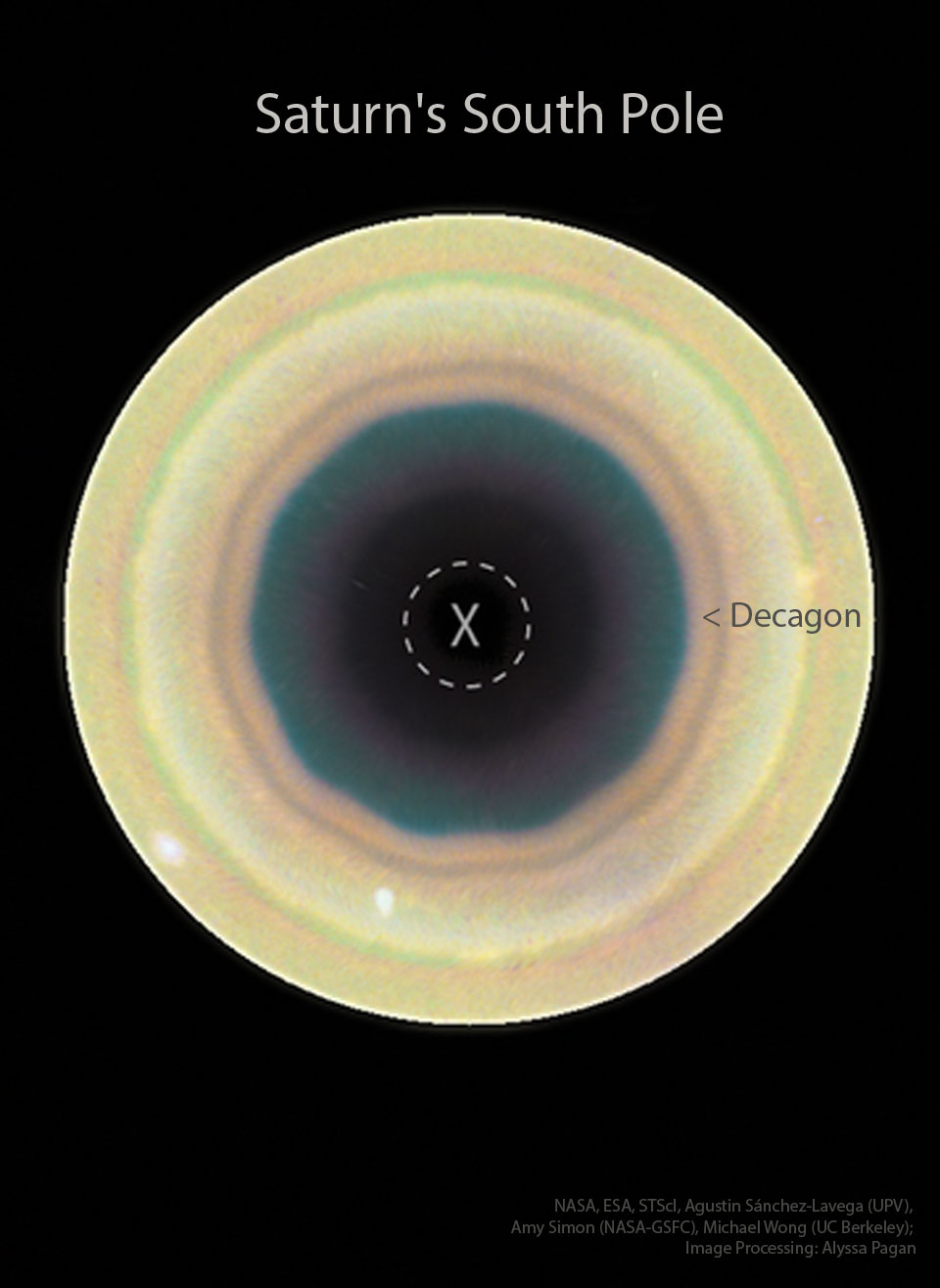
为什么土星的两极是几何的?1987年,美国宇航局的旅行者号宇宙飞船在20世纪80年代早期迅速飞越了土星,并在拍摄的数据中发现了土星北极被六边形(6面)云包围的事实。现在,哈勃太空望远镜最近对土星的观测显示,在南极周围有一个稍微不同的几何云模式:一个十角形(10面)。当远离两极的快速移动的气体与靠近两极的缓慢移动的气体相互作用时,这些几何边界可能是由波引起的。在哈勃去年拍摄的合成图像中,土星的南极被一个X标记,周围环绕着环状云。十角形在黑暗的内部区域最为突出。40多年来,北六边形已经被证明是稳定的,而南十边形的稳定性肯定仍将是一个研究课题。APOD的主要NASA网站正在迁移:从APOD . NASA .gov到science.nasa.gov/apod
查看原文解释
Why are Saturn’s poles geometric? Saturn’s North Pole has been known to be surrounded by a hexagonal (6 sides) cloud since discovery in 1987 in data taken by NASA’s Voyager spacecrafts, which quickly flew past the ringed world in the early 1980s. Now, recent observations of Saturn by the Hubble Space Telescope reveal a slightly different geometric cloud pattern around the South Pole: a decagon (10 sides). The geometric boundaries are possibly caused by waves when the fast-moving gas away from the poles interacts with slower-moving gas closer to the poles. In the featured image composite by the Hubble taken last year, the South Pole of Saturn is marked by an X and surrounded by bands of circulating clouds. The decagon appears most prominent in the dark inner regions. The northern hexagon has proven stable for over 40 years, while the stability of the southern decagon will surely remain a topic of research. APOD's main NASA site is moving: From apod.nasa.gov to science.nasa.gov/apod