Eclipse对
(原标题: Eclipse Pair)
2026-08-29
浏览次数: 1678
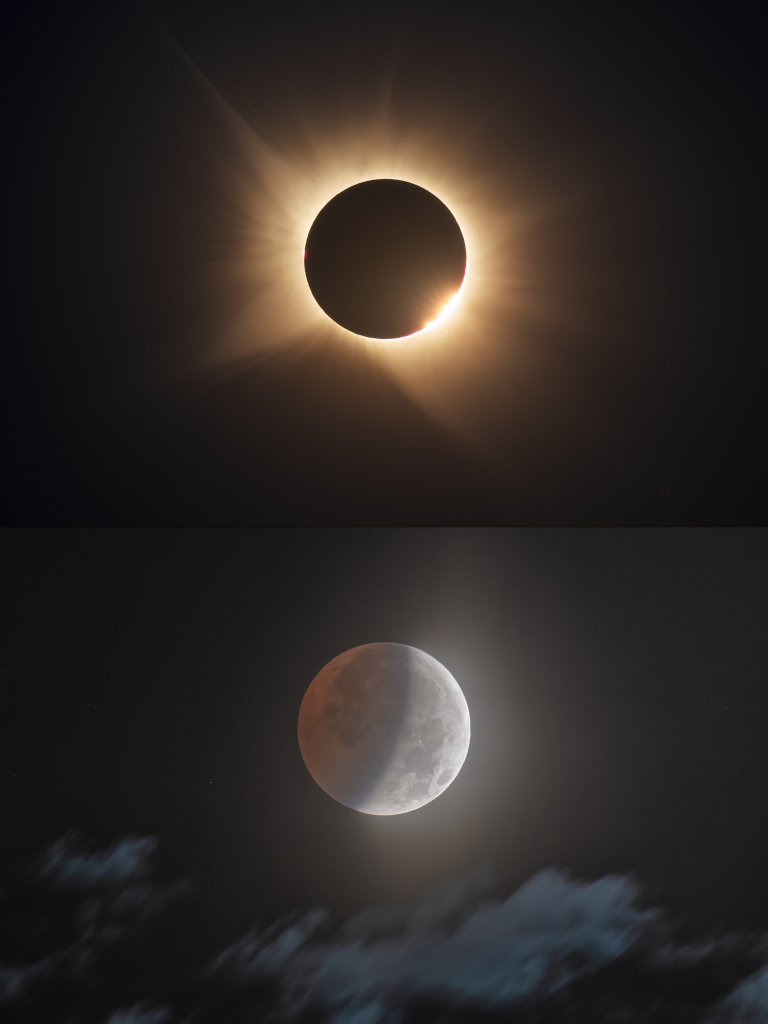
剪报往往是成对出现的。一年两次,在持续约34天的月食季节,太阳、月亮和地球几乎可以排成一线。然后新月和满月,相隔14天多一点,形成了日食和月食。但在一个月食季节,新月和满月的对齐距离足够近,可以同时产生日全食和月全食,这种情况非常罕见。更常见的是,日偏食是任何月食季节的一部分。但是,2026年的最后一个月食季节确实产生了8月12日的日全食(上图)和8月27日/28日的月全食(几乎是月全食)。在新月,这张HDR合成图像捕捉到了西班牙Peñafiel的日食,接近日全食的开始,露出了贝利珠的闪光和金色的日冕。在接下来的满月,深月偏食被记录在法国的savovres。同样是HDR合成图,这张照片显示了这次日偏食在接近93%最大相位的一半的时候,所以在地球的本影中,大约有一半的可见月盘看起来变暗和变红。即将到来的月食季节将在2027年2月6日看到日环食,并在2月20日/21日看到半影月食。不断增长的画廊:2026年8月28日的月食APOD的主要NASA网站正在移动:从APOD . NASA .gov到science.nasa.gov/apod
查看原文解释
clipses tend to come in pairs. Twice a year, during an eclipse season that lasts about 34 days, Sun, Moon, and Earth can nearly align. Then the new and full phases of the Moon, separated by just over 14 days, create a solar and a lunar eclipse. But only rarely is the alignment at both new moon and full moon during a single eclipse season close enough to produce a pair with both total solar and lunar eclipses. More often, partial eclipses are part of any eclipse season. But, the last eclipse season of 2026 did produce this fortnight-separated pairing of a total solar eclipse on August 12 (top) and an almost total lunar eclipse on the night of August 27/28. At New Moon, the solar eclipse was captured at Peñafiel, Spain near the begining of totality in this HDR composite image, revealing a flash of Bailey's beads and a golden solar corona. At the following Full Moon, the deep partial lunar eclipse was recorded from Sèvres, France. Also an HDR composite, the image shows this partial eclipse at closer to half its 93 percent maximum phase, so about half the visible lunar disk appears darkened and reddened within Earth's umbral shadow. The coming eclipse season will see an annular solar eclipse on 2027 February 6 paired with a penumbral lunar eclipse on February 20/21. Growing Gallery: Lunar Eclipse of 2026 August 28 APOD's main NASA site is moving: From apod.nasa.gov to science.nasa.gov/apod
© Gwenaël Blanck