地球的影子与月食可视化
(原标题: Earth's Shadow Visualized with Lunar Eclipses)
2026-08-25
浏览次数: 1675
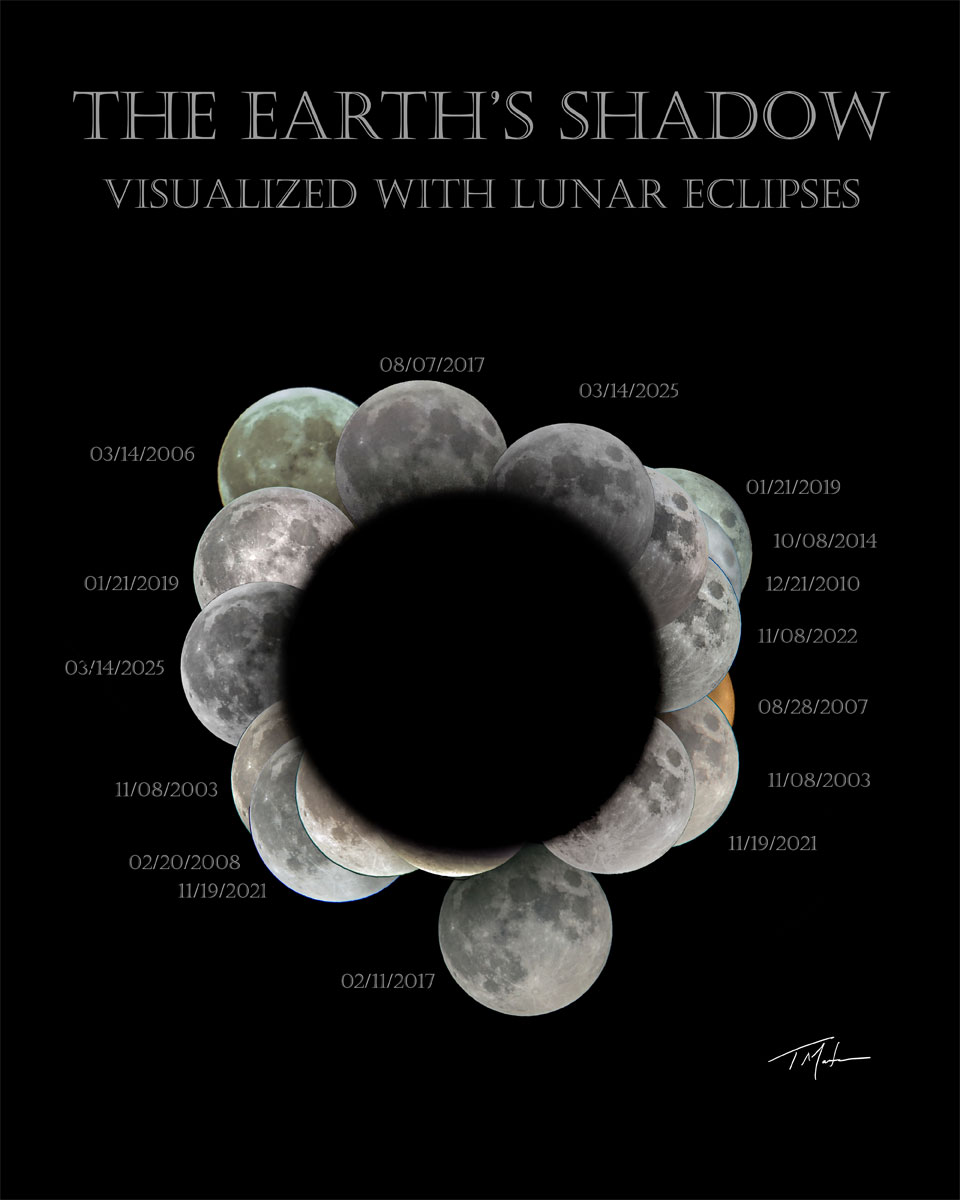
是什么在太空中形成了这个巨大的洞?这不是黑洞,这是一个影子。它是地球的影子。至少从亚里士多德时代开始,人们就注意到,在月偏食期间,地球在月球上的黑影是圆形的——尽管不是一个完整的圆。然而,利用现代数字技术,可以将多次月食的图像组合在一起,显示地球的完整阴影。这张特色图片是由一位持之以恒的天文摄影师根据22年的月食拍摄而成的。月球不会每个月都发生月食,因为月球的轨道相对于地球的轨道有轻微的倾斜。仔细观察一些月食照片,会发现地球大气层过滤掉的红光比蓝光多,这是一条微弱的蓝色带。本周晚些时候,新的月食将会发生,北美、南美、欧洲和非洲的部分地区将会有最好的观测。APOD的主要NASA网站正在迁移:从APOD . NASA .gov到science.nasa.gov/apod
查看原文解释
What’s creating this giant hole in space? This is not a black hole — it’s a shadow. It’s Earth’s shadow. Since at least the time of Aristotle, people have noted that Earth's dark shadow on the Moon during a partial lunar eclipse is circular -- although never a whole circle. Using modern digital technology, though, the images of multiple lunar eclipses can be combined to show Earth's complete shadow. The featured image compilation by a perseistent astrophotographer is constructed from 22 years of lunar eclipses. The Moon is not eclipsed every month (moon-th) because the Moon's orbit is slightly tilted relative to Earth's orbit. Close inspection of some lunar eclipse images shows a faint blue band where Earth’s atmosphere filters out more red sunlight than blue. Later this week, a new lunar eclipse will occur and will be best visible in parts of North and South America, Europe, and Africa. APOD's main NASA site is moving : From apod.nasa.gov to science.nasa.gov/apod
© Tim Martin