看泰坦
(原标题: Seeing Titan)
2026-05-02
浏览次数: 1849
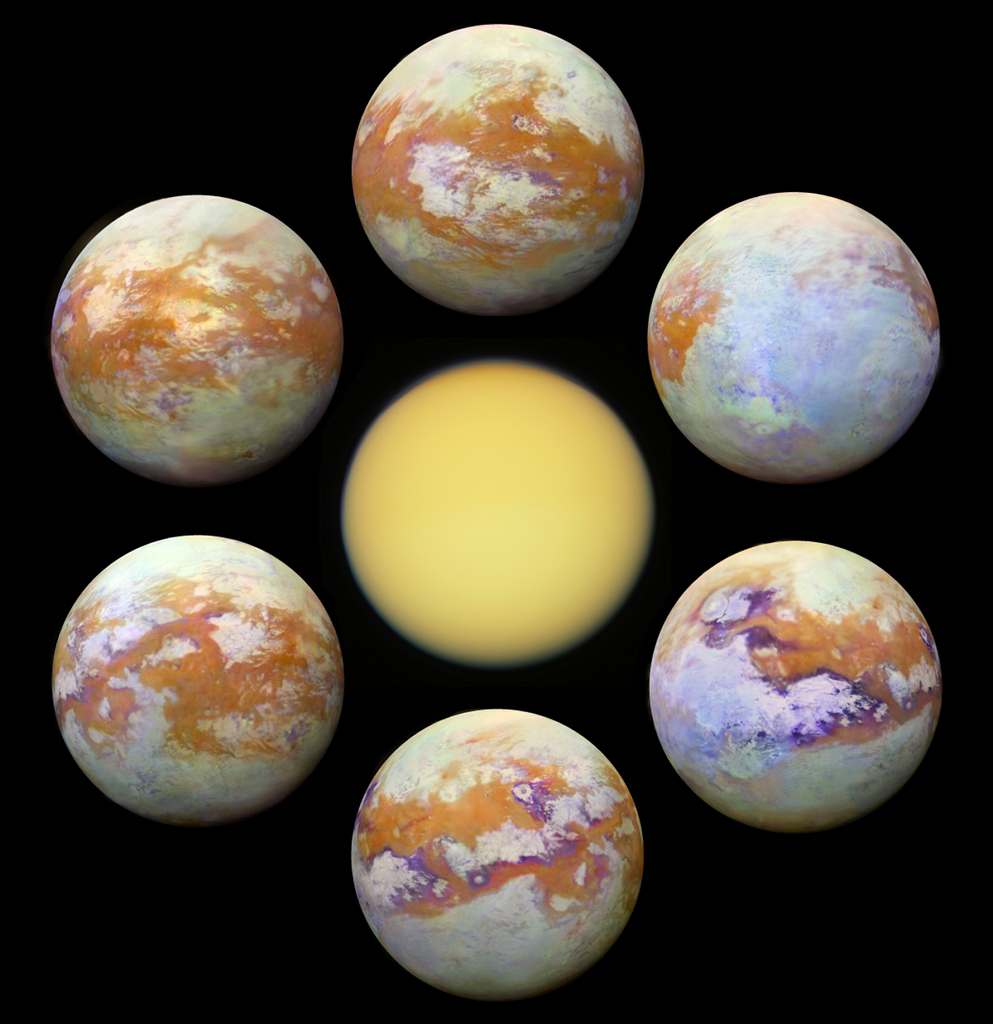
在厚厚的大气层中,土星最大的卫星土卫六的表面很难看到。悬浮在土卫六高层大气中的小颗粒造成了几乎无法穿透的雾霾,强烈散射可见光波长的光,掩盖了表面特征,不被窥探。尽管如此,土卫六表面在红外波段的成像效果更好,因为红外波段的散射更弱,大气吸收也减少了。这张泰坦的可见光图像(中间)周围是迄今为止这颗诱人的卫星最清晰的全球红外图像。这6块面板以假色呈现了对卡西尼号航天器上的视觉和红外测绘光谱仪(VIMS)从2004年到2017年对13年红外图像数据的一致处理。它们与卡西尼号的可见光图像形成了惊人的对比。美国宇航局革命性的土卫六表面旋翼飞行器任务将于2028年7月前发射。
查看原文解释
Shrouded in a thick atmosphere, the surface of Saturn's largest moon, Titan, is really hard to see. Small particles suspended in Titan's upper atmosphere cause an almost impenetrable haze, strongly scattering light at visible wavelengths and hiding surface features from prying eyes. Still, Titan's surface is better imaged at infrared wavelengths, where scattering is weaker and atmospheric absorption is reduced. Arrayed around this visible light image (center) of Titan are some of the clearest global infrared views of the tantalizing moon so far. In false color, the six panels present a consistent processing of 13 years of infrared image data from the Visual and Infrared Mapping Spectrometer (VIMS) on board the Cassini spacecraft orbiting Saturn from 2004 to 2017. They offer a stunning comparison with Cassini's visible light view. NASA's revolutionary rotorcraft mission to Titan's surface is due to launch no earlier than July, 2028.