茧状星云宽视场
(原标题: Cocoon Nebula Wide Field)
2026-09-21
浏览次数: 1385
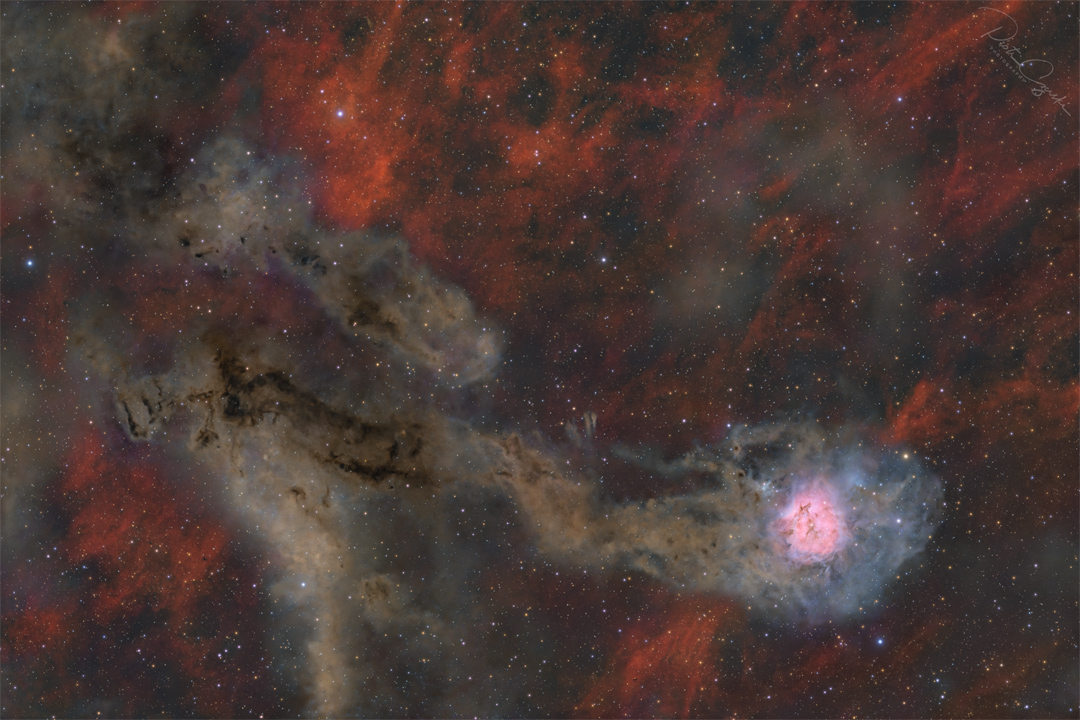
星云什么时候看起来像彗星?在天鹅(天鹅座)高耸的星座内,这片拥挤的星空覆盖了超过2度,眼睛被吸引到了茧状星云。这是一个致密的恒星形成区,宇宙茧在右下方的发射和反射中突出了一个明亮的星云,左边是一长串星际尘埃云,使整个建筑群看起来有点像彗星。编号为IC 5146的星云中央明亮的头部跨度约10光年,而黑暗的尘埃尾巴跨度近100光年。两者都位于2500光年之外。靠近彩色星云中心的一颗明亮的恒星可能会提供能量并帮助清理空腔。尾巴上长长的尘埃细丝,虽然在这张可见光图像中是黑暗的,但却隐藏了形成过程中的恒星。这张特色图片是7月份在美国加利福尼亚州死亡谷拍摄的。APOD的主要NASA网站正在迁移:从APOD . NASA .gov到science.nasa.gov/apod
查看原文解释
When does a nebula look like a comet? In this crowded starfield covering over two degrees within the high-flying constellation of the Swan (Cygnus), the eye is drawn to the Cocoon Nebula. A compact star forming region, the cosmic Cocoon punctuates a nebula bright in emission and reflection on the lower right, with a long trail of interstellar dust clouds to the left, making the entire complex appear a bit like a comet. Cataloged as IC 5146, the central bright head of the nebula spans about 10 light years, while the dark dusty tail spans nearly 100 light years. Both are located about 2,500 light years away. A bright star near the colorful nebula's center likely supplies power and helps clear out a cavity. The long dusty filaments of the tail, although dark in this visible light image, hide stars in the process of formation. The featured image was captured in July from Death Valley, California, USA. APOD's main NASA site is moving: From apod.nasa.gov to science.nasa.gov/apod
© Piotr Czerski