韦伯对M64的看法
(原标题: Webb's View of M64)
2026-09-16
浏览次数: 1525
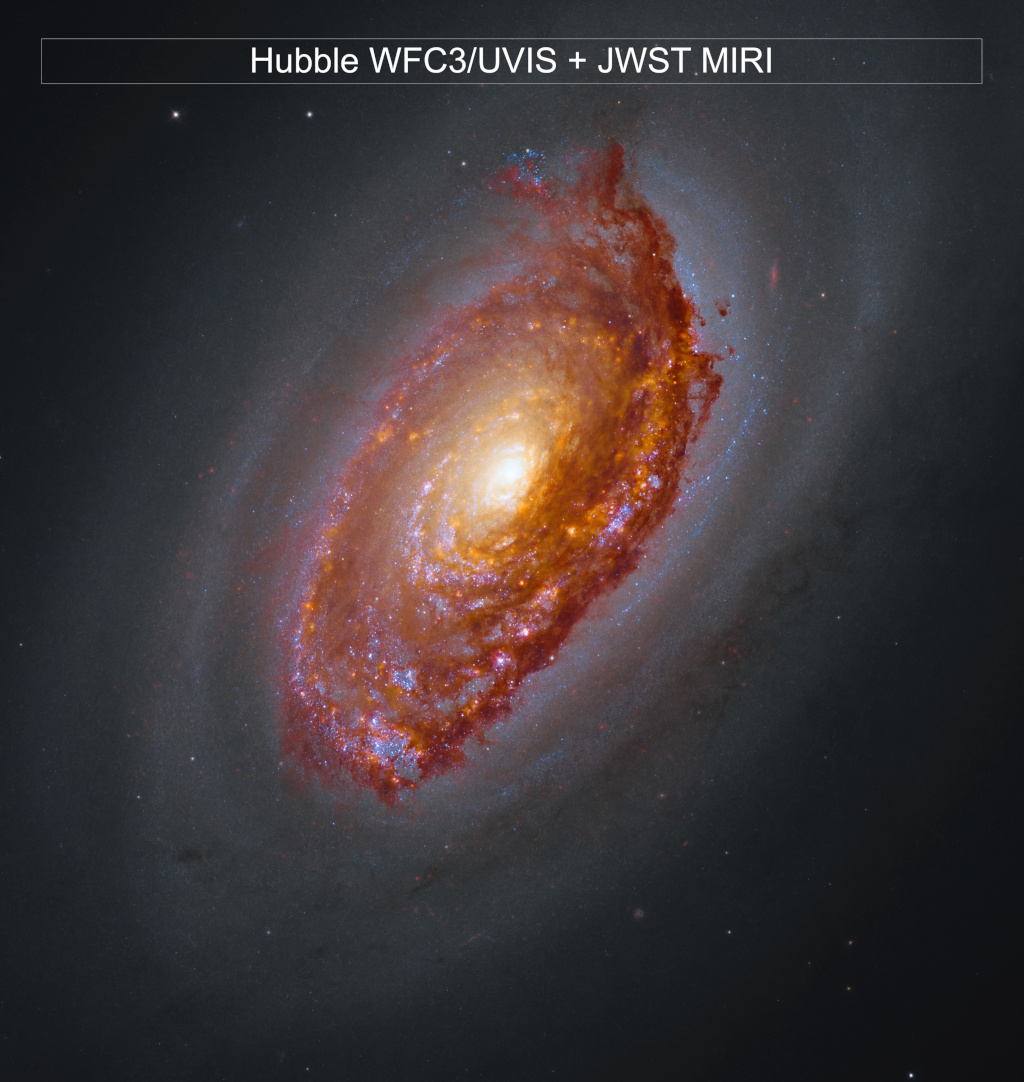
有时候,哈勃发现黑暗的地方,韦伯却看到了光明。一个例子是今天的梅西耶64 (M64)的合成图像,这是一个附近的螺旋星系,有许多名字。黑暗的尘埃带部分阻挡了它明亮的核心,使它获得了“黑眼星系”的绰号。韦伯的中红外仪器(MIRI)看到了红色的尘埃,因为它吸收并重新发射周围新生恒星的光。在哈勃望远镜拍摄的第二张图像中,这些年轻的恒星镶嵌在粉红色的恒星形成区域。M64的内部和外部气体区域反向旋转,在两股气体“流”相遇和压缩的地方产生了更多的恒星形成区域。M64和一个较小的星系之间的合并可能是导致外部气体相反运动的原因。螺旋星系曾经被认为有着和平的历史。M64是旋涡星系,包括银河系,能够并且确实经历合并的关键证据。韦伯对M64的观测将告诉天文学家星系尘埃的结构、运动和组成,并为星系的合并历史和进化增添背景。APOD的主要NASA网站正在迁移:从APOD . NASA .gov到science.nasa.gov/apod
查看原文解释
Sometimes where Hubble finds darkness, Webb sees light. An example is today’s composite images of Messier 64 (M64), a nearby spiral galaxy of many names. The dark band of dust partially blocking its bright core earned it the moniker “the Black Eye Galaxy.” Webb’s Mid-InfraRed Instrument (MIRI) sees that dust, shown in red, as it absorbs and re-emits light from surrounding newborn stars. These young stars are embedded in pink star-forming regions in the secondary Hubble-only image. M64’s inner and outer gas regions counter-rotate, creating regions of increased star formation where the two gas “currents” meet and compress. A merger between M64 and a smaller galaxy was likely the cause of the opposing motion of the outer gas. Spiral galaxies were once thought to have peaceful histories. M64 was key evidence that spiral galaxies, including the Milky Way, can and do experience mergers. Webb’s view of M64 will tell astronomers about the structure, motion, and composition of the galaxy’s dust and add context to the galaxy’s merger history and evolution. APOD's main NASA site is moving: From apod.nasa.gov to science.nasa.gov/apod