英仙座来自英仙座
(原标题: Perseids from Perseus)
2026-08-18
浏览次数: 1675
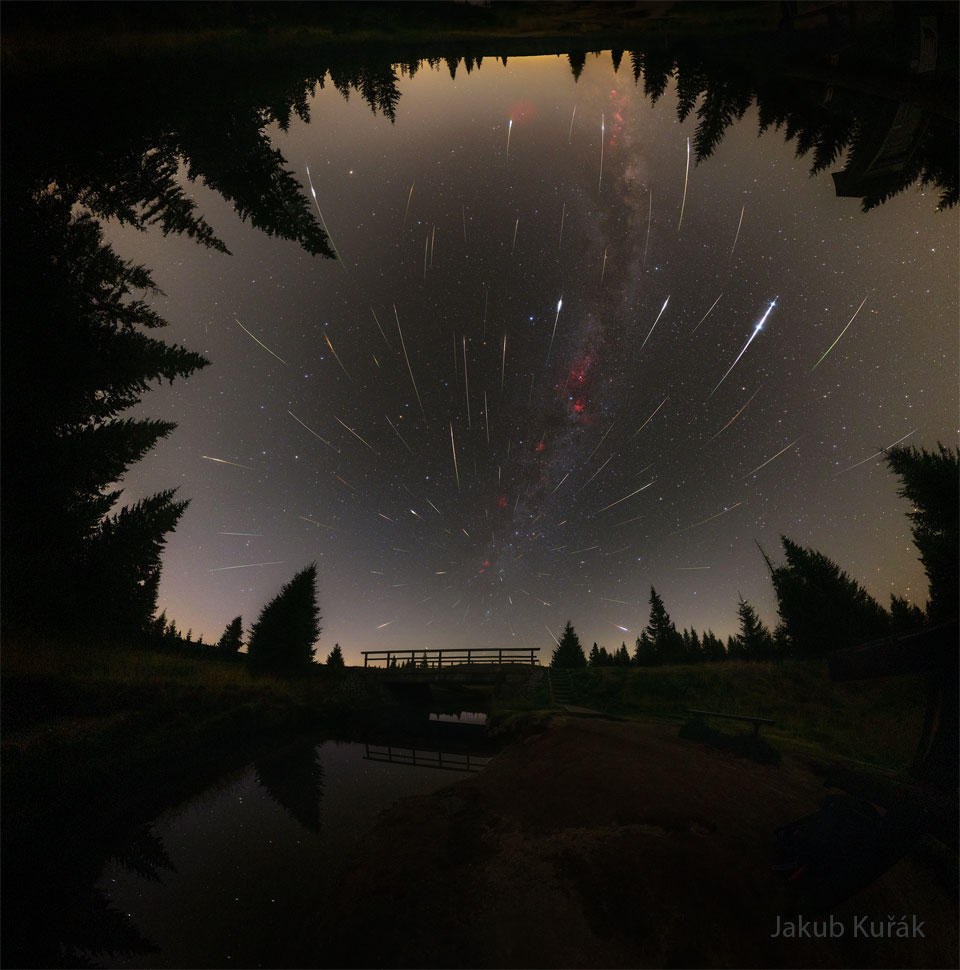
今年是英仙座流星雨的好年份。一个关键的原因是月球没有照亮地球的夜空,所以可见的流星比平时多。月亮在哪里?它正忙着拜访太阳。在英仙座流星雨的高峰期,月亮直接移动到太阳的正前方,造成了格陵兰岛和西班牙都能看到的日全食。英仙座流星雨发生时,地球与斯威夫特-塔特尔彗星释放的太阳轨道碎片流相撞。英仙座流星雨,虽然通常只有沙粒大小,但往往是快速和明亮的,因为斯威夫特塔特尔的碎片绕太阳运行的方向与地球的轨道运动部分相反。这张精选的图片是在捷克共和国的Jizerka的几个晚上积累的,英仙座流星雨的条纹可以追溯到天空中一个单一的位置——它在英仙座的光芒。画廊:2026年英仙座流星雨
查看原文解释
This was a good year for the Perseids meteor shower. A key reason was the Moon was absent from lighting up Earth's night sky so that more meteors were visible than usual. Where was the Moon? It was busy visiting the Sun. Near the Perseids peak, the Moon moved directly in front of the Sun and created a total solar eclipse visible from Greenland and Spain. The Perseids occur when the Earth collides with a stream of Sun-orbiting debris cast off by Comet Swift-Tuttle. Perseid meteors, although typically only the size of a sand grain, tend to be fast and bright because Swift-Tuttle's debris orbits the Sun in a direction partly opposite Earth's orbital motion. In the featured image compilation, accumulated over several nights from Jizerka in the Czech Republic, the Perseids meteor streaks can be traced back to a single location on the sky -- its radiant in Perseus. Gallery: Perseids Meteor Shower of 2026
© Jakub Kuřák