双裂的小行星环状体
(原标题: Double Lobed Asteroid Torifune)
2026-07-14
浏览次数: 1773
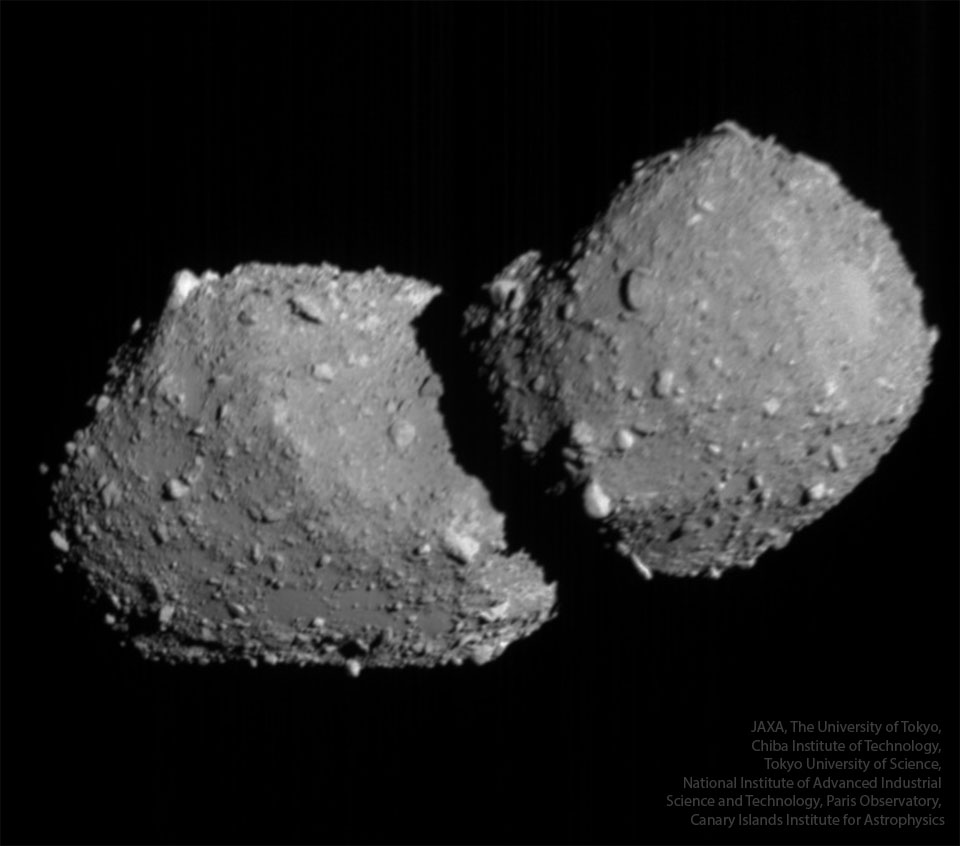
为什么这颗小行星是双重的?本月早些时候,日本机器人宇宙飞船隼鸟2号飞过小行星98943鸟岛并拍摄了照片。虽然之前对遥远地球的观测表明鸟嘴岛是长方形的,但隼鸟2号发现鸟嘴岛实际上有两个相连的叶。这块太空岩石大约有四个足球场那么长,它在绕太阳运行时经常靠近地球,尽管它不会构成威胁。除了这两个裂片,土卫四上还显示出许多巨石,但令人惊讶的是,没有明显的陨石坑,这可能是因为它的表面是一堆碎石。就像小行星Arrokoth一样,似乎每个叶在碰撞并粘在一起之前都是分开形成的。隼鸟2号在2018年遇到了著名的小行星龙宫,现在将在2031年遇到1998 KY26,这是一颗较小的小行星,旋转速度异常快,可能有冰库。
查看原文解释
Why is this asteroid a double? Earlier this month the Japanese robotic spacecraft Hayabusa2 shot past asteroid 98943 Torifune and captured pictures. Although previous observations from distant Earth indicated that Torifune was oblong, Hayabusa2 found that Torifune actually has two joined lobes. With a length of about four soccer fields, this space rock frequently comes near the Earth as it orbits the Sun, although it is not a threat. Besides the two lobes, Torifune shows many large boulders, but, surprisingly, no obvious craters, likely because its surface is a pile of rubble. Like asteroid Arrokoth, it appears that each lobe formed separately before colliding and becoming stuck together. Hayabusa2 famously encountered asteroid Ryugu in 2018, and now heads for an encounter in 2031 with 1998 KY26, a smaller asteroid that rotates unusually fast and might have reservoirs of ice.
© JAXA, U. of Tokyo, Chiba Tech, Tokyo U. of Science, AIST, Paris Obs., IAC