同胞超新星遗迹
(原标题: Sibling Supernova Remnants)
2026-07-02
浏览次数: 1814
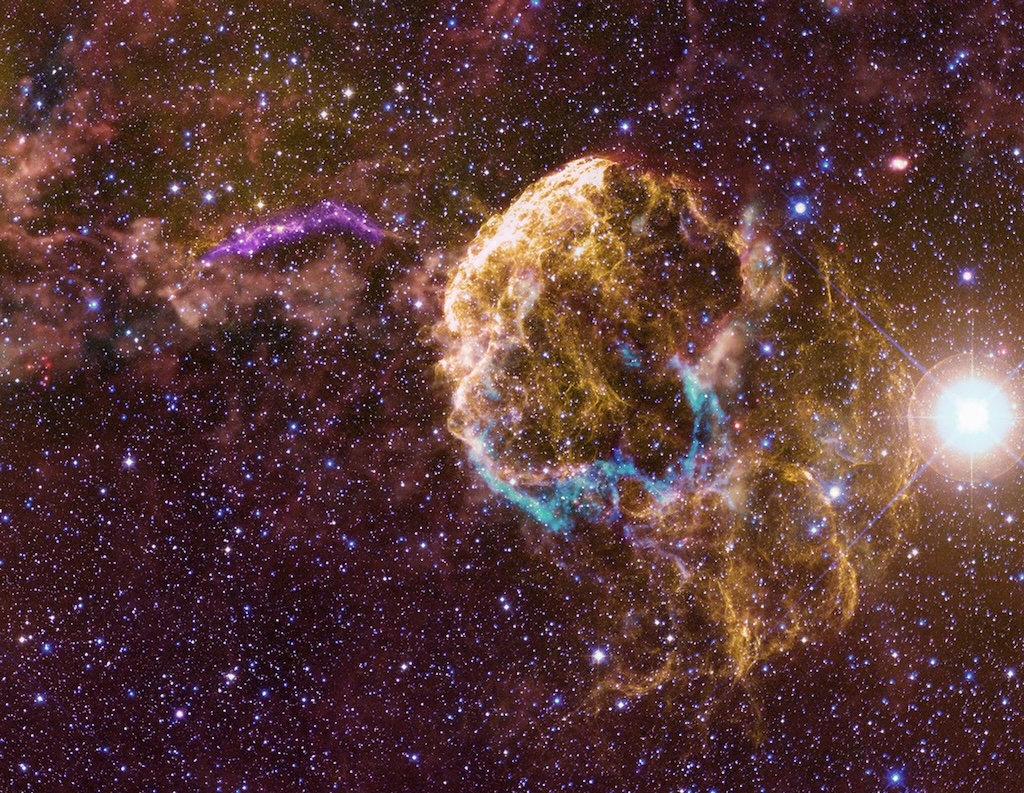
当双星中的一颗恒星变成超新星会发生什么?这张照片结合了可见光(黄色)、紫外光(紫色)和红外光(青色、红色和橙色),显示了大约6000光年外的两颗超新星遗迹及其周围环境。较年轻的是中央著名的水母星云(大部分为黄色)。如果我们能用肉眼看到它,它看起来比天空中的满月还要大。显示为紫色的灯丝是一颗更古老的重叠超新星遗迹G189.6+3.3的一部分。一项新的研究使用了美国宇航局费米伽马射线太空望远镜的数据来拼凑他们的故事。天文学家认为,双星系统中有两颗恒星,然后第一颗恒星爆炸成为超新星,赶走了它的伴星,伴星在数万年后也爆炸成为超新星,形成了我们今天看到的叠加超新星遗迹。右边那颗明亮的恒星实际上是一个三星系统,名叫普洛斯。
查看原文解释
What happens when one of the stars in a binary goes supernova? This image combines visible (yellow), ultraviolet (purple) and infrared light (cyan, red and orange) to show two supernova remnants and their surrounding environment, about 6,000 light-years away. The younger one is the well-known Jellyfish Nebula in the center (mostly in yellow). If we could see it by eye, it would appear larger than the full moon in the sky. The filament shown in purple is part of an older, overlapping supernova remnant, G189.6+3.3. A new study used data from NASA's Fermi Gamma-ray Space Telescope to piece together their story. Astronomers believe that there were two stars in a binary system, then the first one exploded as a supernova, kicking away its companion, which also exploded as a supernova tens of thousands of years later, creating the superimposed supernova remnants we see today. The bright star on the right is actually a triple star system named Propus.