维尔日克彗星的彗尾
(原标题: Tails of Comet Wierzchoś)
2026-02-17
浏览次数: 2375
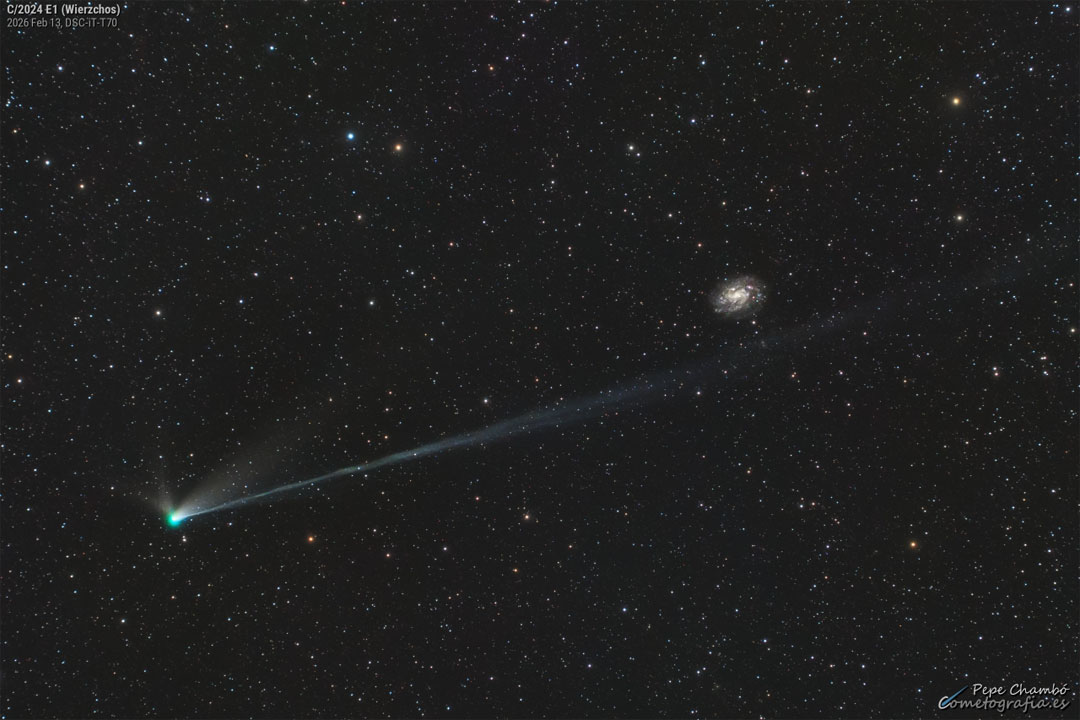
有些彗星是我们太阳系邻居的常客;有些人只来一次,一去不复返。我们再也没有机会看到彗星C/2024 E1 (wierzchoka)了,它目前正在穿过内太阳系。这颗彗星的双曲线轨道表明它很可能成为一名星际旅行者。今天,wierzchoka彗星最接近地球,与地球的距离与太阳的距离大致相同。这张30分钟的照片是上周在智利拍摄的,显示了一条5度长的离子尾巴和三条较短的尘埃尾巴。彗发的绿色色调来自于碳分子在阳光下的分解,但这个过程持续的时间不够长,无法让彗尾也呈现出绿色。在图片的最右边是一个遥远的螺旋星系:ngc300。
查看原文解释
Some comets are regular guests of our solar neighborhood; others come by only once, never to return. We won’t have another chance to see Comet C/2024 E1 (Wierzchoś), which is currently making its way through the inner Solar System. The hyperbolic orbit of this comet indicates that it will likely become an interstellar traveler. Comet Wierzchoś is today near its closest approach to the Earth, passing roughly the same distance from the Earth as is the Sun. The featured 30-minute exposure was taken last week in Chile and shows a 5-degree long ion tail as well as three shorter dust tails. The green hue of the coma comes from the breakdown of dicarbon molecules by sunlight, but that process does not last long enough to also tinge the tails. On the far right lies a spiral galaxy far in the distance: NGC 300.
© José J. Chambó; Text: Cecilia Chirenti (NASA GSFC, UMCP, CRESST II)