一颗白矮星周围无法解释的激波
(原标题: Unexplained Shocks Around a White Dwarf Star)
2026-02-16
浏览次数: 2281
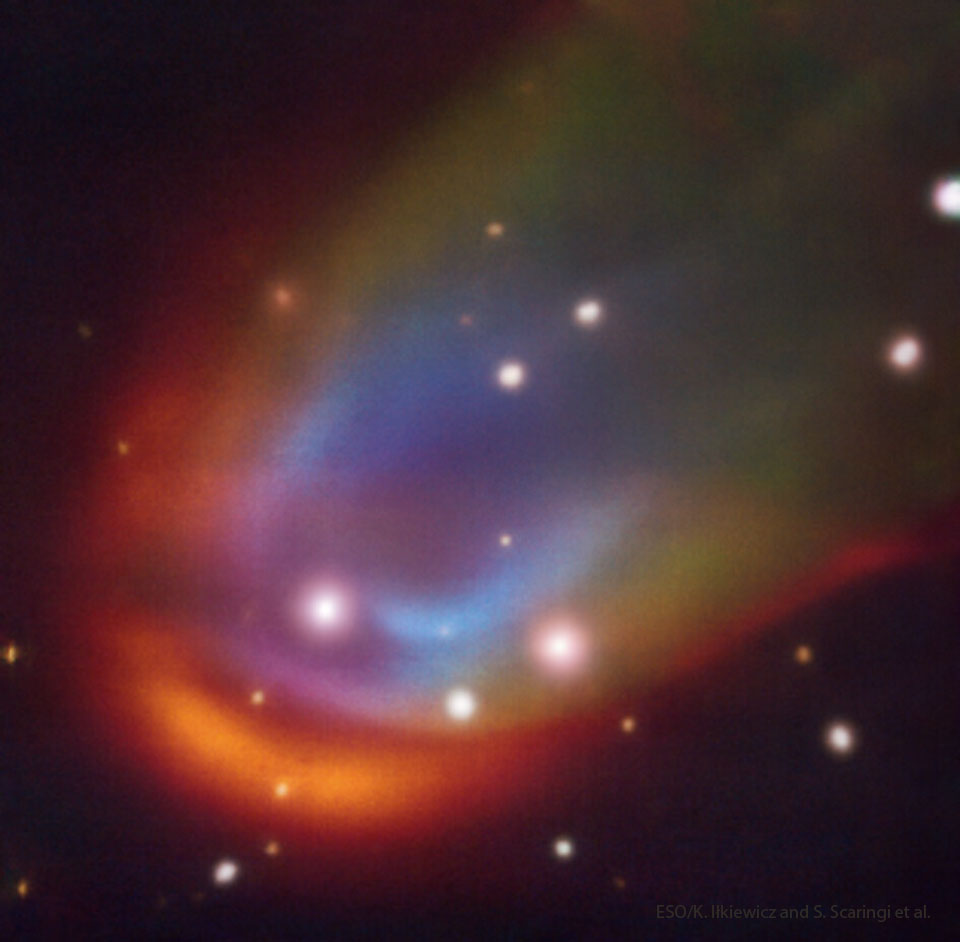
RXJ0528+2838是如何产生这样的冲击波的?最近发现的一颗白矮星RXJ0528+2838距离地球730光年,是两个最大白斑的较左端。大多数恒星在完成核融合以获取能量后,会变成红巨星,而红巨星的核心会以昏暗致密的白矮星的形式存在,在剩下的时间里慢慢冷却下来。白矮星的密度如此之大,以至于唯一能阻止它们进一步坍缩的就是量子力学。大约50亿年后,我们的太阳也会变成一颗白矮星。这张由欧洲南方天文台的甚大望远镜获得的特色图像显示了RXJ0528+2838周围无法解释的弓形激波,类似于一艘快速移动的船只周围的水波。天文学家还不知道这些冲击的动力是什么,它们已经存在了至少1000年。红色、绿色和蓝色代表了发光的氢、氮和氧的微量气体。开放科学:浏览天体物理学源代码库中的3900多个代码
查看原文解释
How is RXJ0528+2838 creating such shock waves? A recently discovered white dwarf star, the farther left of the two largest white spots, RXJ0528+2838, was found 730 light-years away from Earth. Most stars, when done fusing nuclei in their cores for energy, become red giant stars, the cores of which live on as faint dense white dwarfs that slowly cool down for the rest of time. White dwarfs are so dense that the only thing that stops them from collapsing further is quantum mechanics. In about 5 billion years, our Sun will become a white dwarf, too. The featured image, obtained with the European Southern Observatory’s Very Large Telescope, shows unexplained bow shocks around RXJ0528+2838, similar to the bow wave of water around a fast-moving ship. Astronomers don’t yet know what is powering these shocks, which have existed for at least 1,000 years. The red, green and blue colors represent trace amounts of glowing hydrogen, nitrogen and oxygen gas. Open Science: Browse 3,900+ codes in the Astrophysics Source Code Library