CTB 1:髓质星云
(原标题: CTB 1: The Medulla Nebula)
2026-01-19
浏览次数: 2344
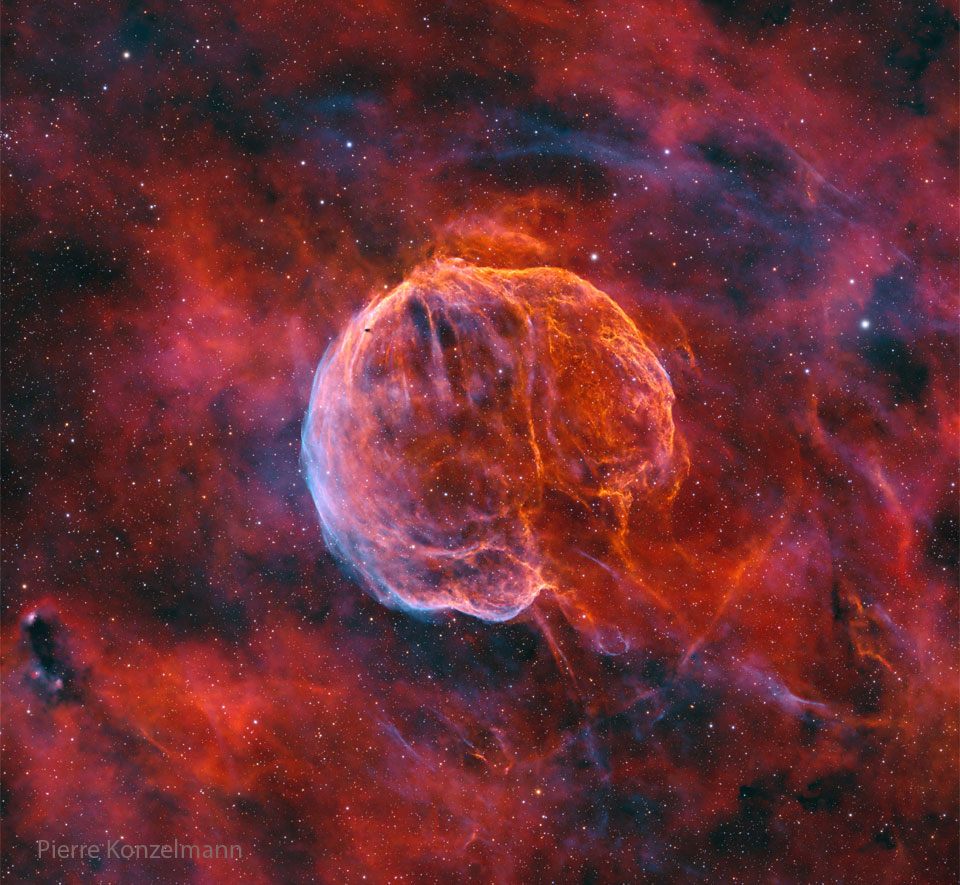
这个不寻常星云的动力是什么?CTB 1是大约1万年前仙后座附近的一颗大质量恒星爆炸时留下的膨胀的气体壳。这颗恒星可能是在其核心附近的元素耗尽时引爆的,而这些元素可以通过核聚变产生稳定的压力。由此产生的超新星遗迹,因其类似大脑的形状而被称为髓质星云,由于与限制性星际气体碰撞产生的热量,它仍然在可见光下发光。然而,为什么星云在x射线下也会发光,这仍然是一个研究课题。一种假说认为,一颗高能脉冲星被创造出来,并以快速向外移动的风为星云提供动力。根据这一线索,在无线电波中发现了一颗脉冲星,这颗脉冲星似乎是由超新星爆炸以每秒1000公里以上的速度喷出的。虽然髓质星云看起来像满月一样大,但它是如此微弱,以至于在美国德克萨斯州的一个小型望远镜上花费了84小时的曝光才创造出这张特色图像。
查看原文解释
What powers this unusual nebula? CTB 1 is the expanding gas shell that was left when a massive star toward the constellation of Cassiopeia exploded about 10,000 years ago. The star likely detonated when it ran out of elements, near its core, that could create stabilizing pressure with nuclear fusion. The resulting supernova remnant, nicknamed the Medulla Nebula for its brain-like shape, still glows in visible light because of the heat generated by its collision with confining interstellar gas. Why the nebula also glows in X-ray light, though, remains a topic of research. One hypothesis holds that an energetic pulsar was created and powers the nebula with a fast outwardly moving wind. Following this lead, a pulsar was found in radio waves that appears to have been expelled by the supernova explosion at over 1000 kilometers per second. Although the Medulla Nebula appears as large as a full moon, it is so faint that it took 84-hours of exposure with a small telescope in Texas, USA, to create the featured image.