气体和尘埃中的仙女座菌株
(原标题: Andromeda Through Gas and Dust)
2026-06-03
浏览次数: 1856
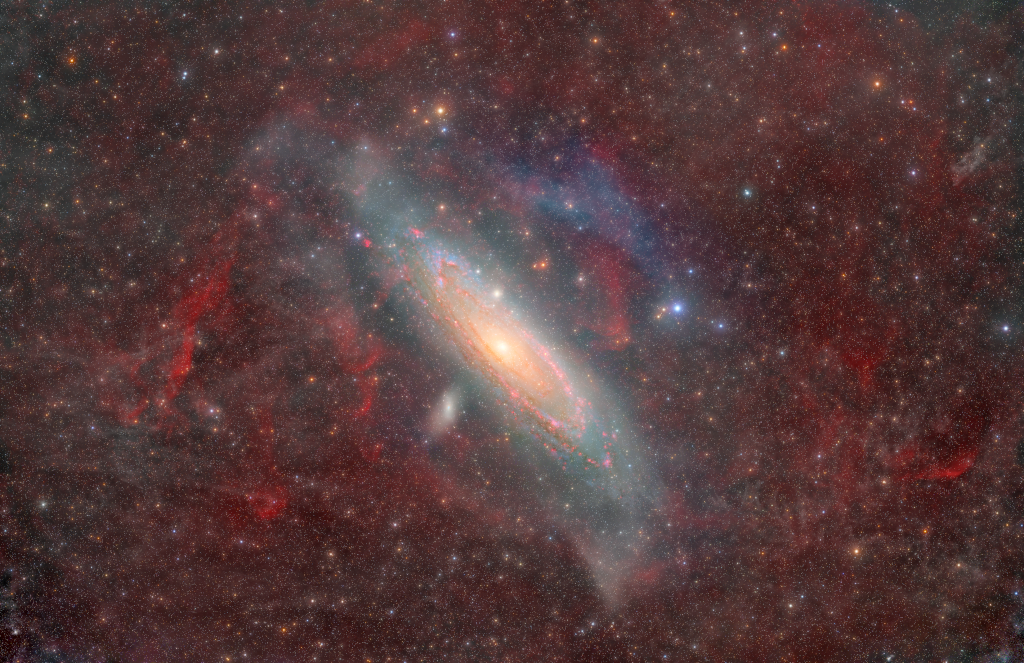
1000多年前,波斯天文学家Abd al-Rahman al-Sufi在《恒星之书》中发表了人类已知的最古老的仙女座星系记录(牛津大学图书馆马什女士144页167页)。800年后,仙女座星云成为查尔斯·梅西耶“星云和星团目录”中的第31个条目。从“一朵小云”到“星云”,现在已知是离我们最近的主要星系,仙女座星系一直是一个基本的天体。今天的这张照片是在202小时内拍摄的,它显示了我们观察邻居的能力已经走了多远。漫射的红色和蓝色云主要是前景电离的氢和氧,远在我们的银河系内。被年轻恒星发出的高能光电离的粉红色氢云在星系的尘埃旋臂上留下了痕迹。M32和M110是环绕较大的仙女座星系的卫星星系。尽管从古代的肉眼到现代望远镜都有很长的观测历史,仙女座星系仍然拥有无数的秘密,天文学家将继续寻找,包括星系如何合并和进化,以及星系所在暗物质的性质。老师!NASA/IPAC教师档案研究计划正式开放申请!
查看原文解释
Over 1000 years ago, Persian astronomer Abd al-Rahman al-Sufi published humanity’s oldest known record of the Andromeda Galaxy in "The Book of Fixed Stars" (Bodleian Library MS. Marsh 144 p. 167). 800 years later, Andromeda became the 31st entry in Charles Messier’s "Catalogue of Nebulae and Star Clusters". From “a small cloud” to “nebula” and now known to be our nearest major galaxy, Andromeda has remained a fundamental astronomical object. Today’s image, taken over 202 hours, shows how far we have come in our ability to observe our neighbor. The diffuse red and blue clouds are mostly foreground ionized hydrogen and oxygen well within our Milky Way. Pink-red clouds of hydrogen ionized by the energetic light of young stars trace the galaxy’s dusty spiral arms. M32 and M110 are satellite galaxies pictured orbiting the larger Andromeda. Despite its long history of observation through ancient unaided eyes to modern telescopes, Andromeda still holds countless secrets that astronomers will continue to search for, including how galaxies merge and evolve, as well as the nature of the dark matter that galaxies reside in. Teachers! the NASA/IPAC Teacher Archive Research Program is officially open for applications!
© Nick Fritz Text: Keighley Rockcliffe (NASA GSFC, UMBC CSST, CRESST II)