萨克雷的小球
(原标题: Thackeray's Globules)
2026-05-25
浏览次数: 1892
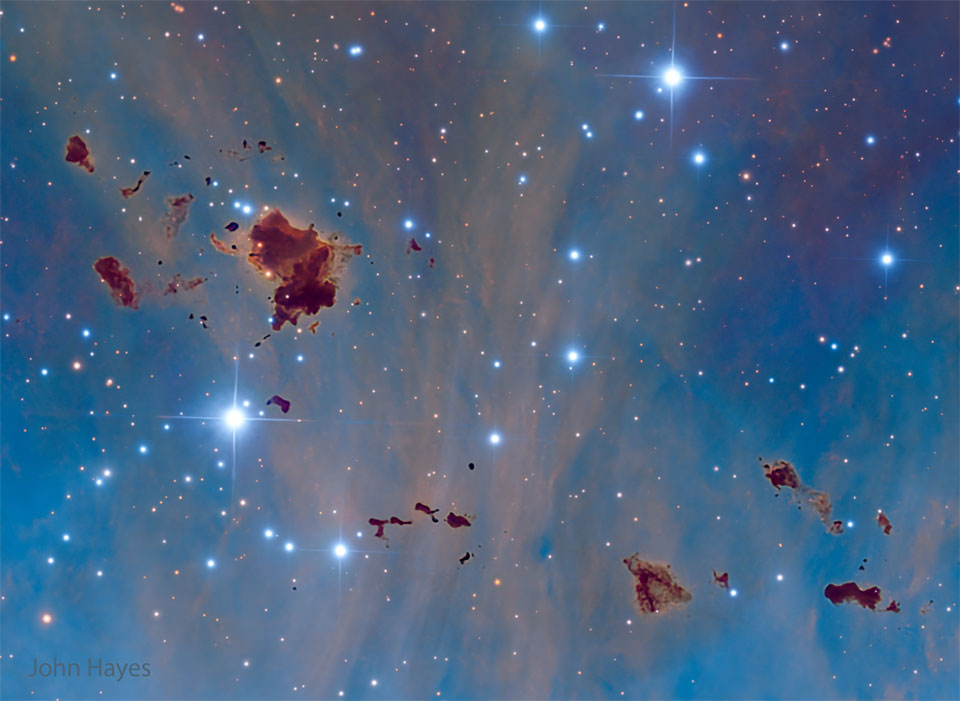
这些奇怪的太空球体是什么?这些不透明的星际尘埃和气体云位于丰富的恒星场和发光的氢气中,它们非常大,可能能够形成恒星。他们的家被称为IC 2944,这是一个明亮的恒星托儿所,距离半人马座(半人马座)约7600光年。1950年,萨克雷(a . D. Thackeray)在南非用望远镜首次发现了其中最大的一个暗球体,它可能是两个独立但重叠的云,每个云的宽度都超过一光年。与其他数据一起,来自智利El Sauce天文台的特色哈勃调色板图像表明,由于来自年轻,炽热恒星的强烈紫外线辐射已经激活并加热了明亮的发射星云,Thackeray球状体破裂并翻动。已知与其他恒星形成区域有关的这些和类似的暗球状物最终可能会被它们的恶劣环境所消散——就像宇宙中的黄油块在热煎锅里一样。星际拼图:每日天文拼图
查看原文解释
What are these strange space globs? Situated in rich star fields and glowing hydrogen gas, these opaque clouds of interstellar dust and gas are so large they might be able to form stars. Their home is known as IC 2944, a bright stellar nursery located about 7,600 light years away toward the constellation of the Centaur (Centaurus). The largest of these dark globules, first spotted by A. D. Thackeray in 1950 using a telescope in South Africa, is likely two separate but overlapping clouds, each more than one light-year wide. Along with other data, the featured Hubble palette image from the El Sauce Observatory in Chile, indicates that Thackeray's globules are fractured and churning as a result of intense ultraviolet radiation from young, hot stars already energizing and heating the bright emission nebula. These and similar dark globules known to be associated with other star forming regions may ultimately be dissipated by their hostile environment -- like cosmic lumps of butter in a hot frying pan. Interstellar Jigsaw: Astronomy Puzzle of the Day
© John Hayes