韦伯和哈勃:IC 5332
(原标题: Webb and Hubble: IC 5332)
2026-02-26
浏览次数: 2026
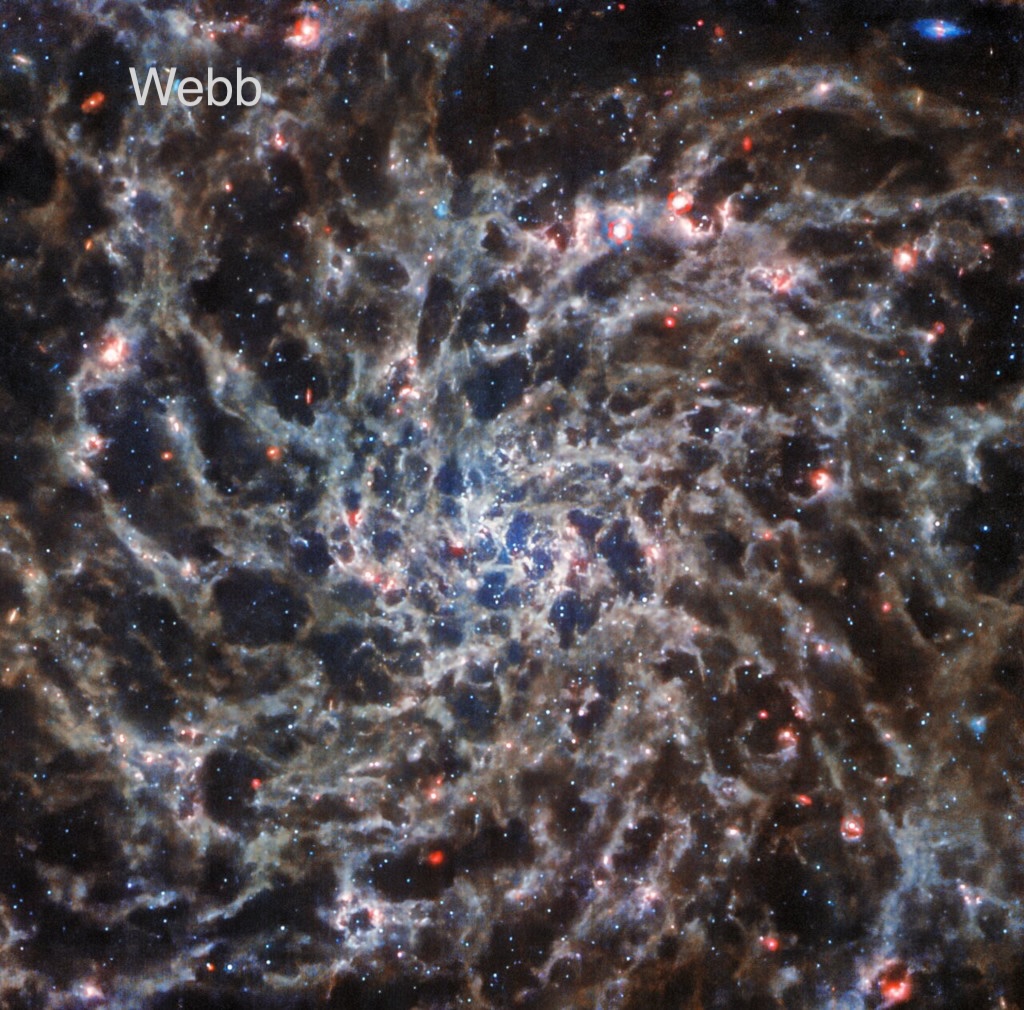
透过红外线护目镜看宇宙是什么样子?我们的眼睛只能看到可见光,但天文学家希望看到更多。今天的APOD显示了两个NASA望远镜所看到的螺旋星系IC 5332:韦伯在中红外线,哈勃在紫外线和可见光。要在两个基于空间的视图之间切换,只需将光标滑动到图像上(或点击此链接)。哈勃图像突出显示了被黑暗区域隔开的星系旋臂,而韦伯图像显示了一个更精细、更纠结的结构。星际尘埃散射并吸收来自星系中恒星的光,在哈勃图像中形成黑暗的尘埃带,然后在红外光中释放热量,因此在韦伯图像中尘埃发光。韦伯上的中红外仪器需要在-266ºC(或- 447ºF)的低温下工作,否则它会探测到望远镜本身的红外辐射。结合这些观测结果,天文学家将气体和恒星的“小尺度”与星系结构和演化的真正大尺度联系起来。
查看原文解释
What does the universe look like through infrared goggles? Our eyes can only see visible light, but astronomers want to see more. Today’s APOD shows spiral galaxy IC 5332 as seen by two NASA telescopes: Webb in mid-infrared and Hubble in ultraviolet and visible light. To toggle between the two space-based views just slide your cursor over the image (or follow this link). The Hubble image highlights the spiral arms of the galaxy separated by dark regions, whereas the Webb image reveals a finer, more tangled structure. Interstellar dust scatters and absorbs light from the stars in the galaxy, causing the dark dust lanes in the Hubble image, and then emits heat in infrared light, so dust glows in this Webb image. The Mid-InfraRed Instrument on Webb needs to operate at a chilling temperature of -266ºC (or - 447ºF), otherwise it would detect infrared radiation from the telescope itself. Combining these observations, astronomers connect the “small scale” of gas and stars to the truly large scale of galactic structure and evolution.